
AI Isn’t Replacing Staff, It’s Changing the Business Model
Article7 min read
A decade ago, a dental practice could hold a margin above 30%. Today, the average sits near 22%. Insurance reimbursement keeps sliding, every cost line keeps climbing, and hiring staff to run the place gets harder and more expensive. These numbers are for dental, but the same pressure is bearing down on veterinary, optometry, and...
A decade ago, a dental practice could hold a margin above 30%. Today, the average sits near 22%. Insurance reimbursement keeps sliding, every cost line keeps climbing, and hiring staff to run the place gets harder and more expensive. These numbers are for dental, but the same pressure is bearing down on veterinary, optometry, and specialty practices.
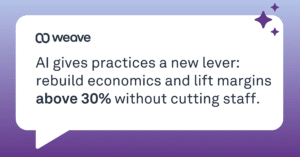
You can’t cut your way back up to 30%. But for the first time, you don’t have to. AI gives a practice a lever it never had before: a way to rebuild the economics from the inside and lift margins back above 30% without shrinking the team. It changes the two things a business model is made of – what the practice costs to run and how it earns.
That isn’t a guess. It comes from watching how practices actually run, across more than 40,000 locations and over a billion patient interactions a year. That’s the vantage behind our Practice of 2036 Report, and the practices that rebuild on purpose come out ahead.
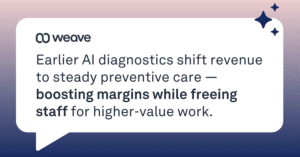
AI keeps getting better at the work it does. On the cost side, agents shift the administrative load to software so the same team can run a bigger practice. Labor becomes a smaller share of revenue because the practice grows, not because anyone leaves. On the revenue side, as AI diagnostics catch problems earlier, revenue shifts from big corrective procedures to steady preventive care. If you get both right, your practice runs at a higher margin than it does today, with your team focused on the more valuable work.
Your Cost Base Shifts From Labor to Software
Staff compensation is the single largest expense in a practice today, accounting for more than 40% of overhead. A big share of your staff’s time is dedicated to repetitive admin work: entering data, verifying insurance, chasing claims, and confirming appointments. As AI takes that on, your team’s valuable attention can go to the patient in the chair. That front-office work – the call answered, the reminder sent, the payment collected – is exactly what Weave has built for two decades. What’s new is that AI can run more of it on its own, and the software line on a P&L, historically 2 to 3% of revenue, is likely to reach 6 to 9% over the next decade.
That rising software line is leverage, not a new burden. It does work at a scale a front office never could on its own. The software can run continuously, nights and weekends included, without added overhead. This means that a practice’s growth, whether that means more patients or another location, stops adding cost the way it used to. Finance people call that operating leverage. For a practice at today’s compressed 22% margin, rebuilding the cost base this way could bring margins back to 28 to 32%. For a group, the effect repeats in every location, which is why the report calls it “the largest operating-leverage opportunity available anywhere on the P&L.” That is how the cost side of the model changes.
That shift shows up on your P&L in impactful ways:
- Labor: A smaller share of revenue
- Software: Potential to be 6 to 9% of your revenue
- Margin: Back up to 28% – 32%
That’s the business model changing. The higher margin comes from a bigger practice, not a smaller team. And cost is only half of the rebuild; the other half is revenue.
Your Revenue Shifts From Corrective to Preventive
The other half of the rebuild changes where the money comes from. When AI catches a problem earlier, the fix is smaller: the early catch instead of the major repair. If you do that across a full schedule, the service mix tilts toward lighter, preventive care.
It raises a fair question. If the work gets smaller, doesn’t the revenue shrink with it? The Practice of 2036 report answers that directly: “Revenue per visit will likely decline modestly. Total revenue and lifetime patient value will almost certainly rise.”
Three things drive that.
The first is throughput. A chair that once turned over 8 times a day can handle 10 to 12 when the visits are shorter, and the gaps that used to sit empty between long procedures fill in.
The second is retention. Catching a problem early keeps the patient healthier, more loyal, and more likely to refer. One patient who stays fifteen years is worth more than a single procedure billed once, and that loyalty is easier to earn when your front desk has the time to make people feel looked after. It compounds on the top line in a way one big case never can.
The third is the size of the room you have to grow into. In dentistry alone, more than 100 million people, about a third of the country, go without oral care in a given year. More short visits need more patients to fill them, and the pool to draw from is big. Filling it is exactly why the front office becomes a growth engine instead of a cost center.
The shift toward corrective care opens a revenue model that used to be too much work to run. Membership and subscription plans lived or died on recurring billing, eligibility checks, and reminders; the same admin AI now handles. When you remove the overhead, those membership or subscription plans become more viable revenue options, which turns scattered one-off visits into steady revenue. Veterinary practices have already proven this with wellness plans.
So the revenue doesn’t shrink. It changes the source. And that shift raises a new question: what does it mean for the software cost behind the model?
The Margin Depends on Managing the Software Spend
Rebuilding the model also changes what you manage. Labor used to be the cost you watched most closely. In the new model, software takes a bigger seat and earns the same scrutiny.
AI carries cost on two levels. The first is a license fee, a predictable subscription that looks like the software contracts you already sign. The second is the usage cost. Every time an AI model reads an insurance card, drafts a note, or handles a call, it burns a small unit of computing that the vendor pays for. Some vendors pass some or all of that through as you use it, while others fold it into a flat rate. Knowing which one you’re buying is the first question to ask.
One cost practices often miss is the rollout. Integrating the tools, training the team, and deciding what your agents can handle on their own. In year one, that often runs as high as the software itself.
So budget your AI software like any major cost: license, usage, and setup, each as its own line. Ask a vendor what a heavy month runs, not just the sticker price. If you do that, the payoff isn’t just a better margin; it’s a better business, and that matters when you price the practice.
The Rebuilt Business Model Earns a Higher Valuation
The cost and revenue shifts change how the practice runs day to day. They also change what the practice is worth. When someone prices a practice for a sale, a loan, or a partner buy-in, the number depends on how reliable the earnings are, not just the size of the profit.
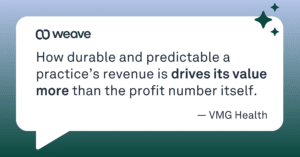
VMG Health, a healthcare valuation firm, is blunt about it: how durable and predictable a practice’s revenue is drives its value more than the profit number itself. So the recurring revenue you built for steadier operations is exactly what a buyer or partner pays a premium for. Two practices can post the same profit, and the one with recurring revenue is valued higher, whether it’s one office or three hundred. That’s why the rebuilt model matters beyond operations.
The Window Is Open Now
Over the next decade, the distance between the practices that rebuild the practice’s business model and the ones that don’t will keep widening. On one side: higher margins, fuller schedules, teams that stay, and stronger valuations. On the other: labor-heavy, corrective-heavy practices, carrying a little more pressure every year. And every year, that gap becomes harder to close.
AI gives your practice a lever the last decade didn’t offer: a way to rebuild how the whole business makes money. The practices that pick it up first will pull ahead, and that opening is here now.
Read Weave’s Practice of 2036 Report to see what the next decade will look like.
Ideas to help your practice grow.
Get practical insights, patient communication tips, industry trends, and new ways to increase efficiency and revenue—delivered monthly.


Ready to grow your practice?
See firsthand how Weave can help you grow your practice.