
The DSO Growth Blueprint: Using an Agentic Teammate to Grow Value Across Locations
Two dental groups can look the same on paper. The same offices, same procedures, same revenue in the same markets, but one can be worth significantly more than the other. That difference in enterprise value changes the game for dental service organizations (DSOs): it decides how you raise money, how you pay and build your staff, what you can afford to do next, and the number you get if you sell your business.
The gap between a thriving and a struggling practice is made of ordinary moments. A patient calls to book, reaches voicemail, then decides to call the practice down the street instead. Another patient leaves after a procedure with a treatment plan they meant to schedule, and never does. A balance goes uncollected because no one followed up. The demand was there, but the revenue never materialized. On a slow day, this revenue loss is a rounding error, but compounded across locations, it is substantial money out the door.
Ten years ago, the solution might have been hiring more staff, but in 2026, the solution is more technical: implementing agentic AI.
Agentic AI works autonomously to handle time-consuming administrative tasks on its own. Offloading this daily busywork to an always-on AI teammate gives people back the valuable time they need to make healthcare more human and transforms patient interactions into repeatable revenue.
The Cost of One Missed Call
Let’s follow the impact of one call all the way up the levels of a DSO:
At one of the group’s offices, a patient calls during the busiest time of the day to book a cleaning. The line rang while the front desk was mid-checkout with someone else, and no one answered it. By the time anyone noticed, the patient booked with the practice down the street.
The missed call isn’t an indictment of your skilled staff: The best office manager can still only answer one call at a time. And every call she takes equals a task she has to set down. There are simply more calls than hands most of the time.
At the corporate office, missed calls look like a location running soft, production under its potential, margin thinner than the model promised. The atrophy is subtle, and judgment lands on the wrong things: the local team, the marketing budget, a slow market. The real problem can’t be solved because no one actually knows what it is.
To an investor, the missed call weakens what buyers call Quality of Revenue (QoR): how durable and predictable earnings are. Revenue that depends on whether the right person, or any person, caught the phone is fragile, exposed to every staffing gap and every rough week. That’s the kind of revenue a buyer marks down. Low QoR shows up as a lower multiple when the group sells.
One call quickly becomes a lost patient, a thinner margin, and a reduced offer at the deal table.
The Same Call, Captured
Now send that call into a group already running an agentic teammate.
At the front desk, the agentic AI teammate is a buffer, not a replacement. It answers the call whether or not a person is free, including after hours. It handles routine questions, books appointments, and routes complicated calls back to a person with the context already attached. That gives the team time to focus on the patients in the room, which is the work only a person can do.
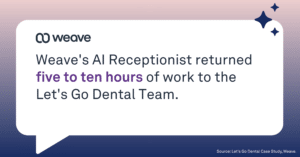
When Let’s Go Dental, a sixteen-location group in El Paso, put Weave’s AI receptionist to work, it returned five to ten hours a week to the team. “Previously, we had to listen to hundreds of calls manually, which was exhausting and inefficient,” Vincent Martinez, their marketing director said.
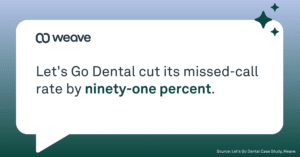
At the corporate office, they see a location running at full capacity, without adding to payroll. Let’s Go Dental cut its missed-call rate by ninety-one percent, down from a rate that had run as high as one in three, and that recovery converted into one to three more patients a week. Multiply that across every location, and the small recoveries stop being small and turn into real revenue.
To an investor, the group that automatically captures demand is the better investment. Its revenue is predictable, no longer hinging on who is at the front desk. That durability is what a buyer pays for. Growth that comes from the locations you already own, not just the next ones you buy.
The Next Right Step
The AI teammate that answers every call, books the appointment, and follows up on unpaid balances exists today.
The groups that move now will turn everyday patient interactions into revenue. For those serious about their growth and what it’s worth, this is the right next step.
This blueprint breaks down how to take it.
The Blueprint: Four Pillars
In a DSO built for agentic AI, every location runs on one platform. What one office does, every office does. Patients move forward the moment they reach out — by voice, text, form, or after-hours message — with their context already attached. The revenue cycle opens with insurance verification before the visit and closes with the balance collected on the same rails.
You get there through four pillars: Capture, Convert, Connect, Secure.
Pillar 1 — Capture: Turn every inquiry into a booked patient
Capture is all about reimagining the acquisition process and rebuilding it to run at DSO volume.
Multi-location groups are being squeezed from every direction. Overhead costs like payroll, rent, insurance, and supplies are climbing, while revenue growth is irregular at best. And same-store revenue growth flattens because added revenue depends on staffing.
When offices are built to include an AI teammate, they operate on an automated system that runs at every entry point. What becomes the normal:
- Every call, text, form, and after-hours message enters the system without waiting on a free person.
- Missed calls trigger a text back the same minute.
- Web visitors land on scheduling that works right then.
- Recall and reactivation run and log themselves.
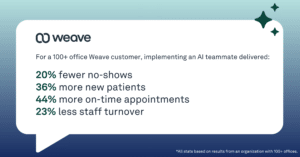
For one Weave customer with 100+ offices, the data around implementing an AI teammate paints a clear picture:
- 20% fewer no-shows
- 36% more new patients
- 44% more on-time appointments
- 23% less staff turnover
| Redesign patient intake as an AI-first, human-supervised flow.
What this rebuilds: How the group takes in patient demand. Every call, text, form, and after-hours message gets into the system without waiting on a person to be free. The enterprise-value line: Same-store growth. Recovered demand the group already pays for. How Weave helps: AI Receptionist (agentic text, live), Missed Call Text, Online Scheduling, Digital Forms, Phones with Call Pop. |
Pillar 2 — Convert: Collect what every location earns
Convert is about a revenue cycle built to run the same way at every office, so what the group earns is what a buyer prices.
The revenue a group earns and the revenue it collects are often two different numbers, and the gap between them balloons before most owners even realize what is happening. Shifting to disciplined revenue cycle management closes this gap.
By layering in agentic AI, the revenue cycle stops being a stack of handoffs and becomes a system. What becomes the normal for every location:
- Insurance eligibility is verified before every visit.
- Patients pay their way: terminal, text-to-pay, saved card, online, or a plan spread over time.
- Overdue balances trigger follow-up automatically, and days-in-AR trends down.
- Financing like CareCredit surfaces early in the conversation, not after the work is done.
- Overdue balances get collected in bulk, straight from the system of record.
Enterprise value is what the whole group is worth to a buyer. Buyers price it against the group’s Quality of Revenue (QoR), a plain measure of how durable and predictable the revenue actually is: Is it earned consistently across locations, or does it swing on which locations had their best RCM person on staff that quarter? (source: VMG Health, 2026) A group whose revenue cycle runs the same way everywhere earns a higher multiple than one whose numbers depend on individuals.
|
Pillar 3 — Connect: Growth without bloating the tech stack
Connect is about rebuilding the operating platform so growth doesn’t scale the complexity of your technology.
A multi-location group’s front offices often run six or seven technologies across the locations, each bought to solve one problem (e.g., phones, forms, etc.). When acquiring new offices, systems are rarely removed, which means new technology is added with every deal. The result is an unwieldy tech stack that corporate must manage and IT has to patch together.
When the group is rebuilt for an agentic AI teammate, the platform underneath it consolidates. What becomes the normal:
- One platform holds phones, texting, payments, forms, scheduling, reviews, and analytics.
- One admin login allows corporate see and manage every location.
- Reports reconcile because nothing is missing.
- Front-office work and corporate reporting run on one system, not two stitched together at month-end.
One place for every customer interaction.
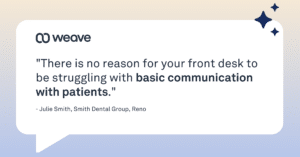
A dental practice in Reno had been using Weave for years when a new office manager persuaded them to switch to a competing patient engagement tool. The change lasted just two months when they saw the way texts lagged, team chat notifications never arrived, and sticky notes got lost in the shuffle. The practice’s IT manager put it plainly: “There is no reason for your front desk to be struggling with basic communication with patients.”
That’s just one office feeling the friction within weeks. Multiply that disconnect across twenty locations, and the group ceases to act like a group at all.
|
Pillar 4 — Secure: Make compliance portfolio-wide
Secure is about a systemic approach to compliance, not a per-location gamble.
Security drift is one tax a multi-location group pays for growth by acquisition. Every location that comes into the business brings its own passwords, permissions, and policies about who can see what.
Each vendor introduces one more surface where patient data could leak, and one more thing a compliance auditor asks about. And every element that corporate can’t audit consistently across the offices becomes part of what a buyer discounts the group for at exit.
When the group is rebuilt with their agentic AI teammate on a single platform, security becomes portfolio-wide. What becomes the normal:
- Access controls scale by role, not by location.
- SSO and MFA apply everywhere at once.
- IP restrictions are set at the portfolio level.
- Uptime is the platform’s problem, not the front desk’s.
- New locations inherit the full posture on day one.
|
Making the Blueprint Real
The transformation to a group with a fully embedded agentic AI teammate is a project that impacts the business at every level. Here’s where to make sure your plan is thorough:
At the practice. Adoption is where the rebuild is actually tested, and the team runs that test. Plan for training time built into the day, not just stolen in minutes between patients. As the team gets up to speed, the learning curve will feel slow at first as the workflows switch. Find champions at each location who can learn first, adopt fully, and help carry teammates through the change. Adoption happens when the team is given the time and resources to get up to speed.
At the corporate office. Corporate sets the pace across the portfolio. If you’re doing a phased rollout by pillar, start first with capture and convert, then move on to connect and secure.
At the investor level. The rebuild must happen without stalling the business, and that means a timeline that finishes in defined quarters, not open-ended phases. Report through the transition regularly, so progress shows up as planned. When this change is owner-led, not IT-delegated, you focus on the group as a whole.
You will see higher friction short-term as people get familiar with the new systems and workflows. When you expect that, you can plan for it and get up and running faster. The rebuild into a full agentic DSO is doable with a strong change management plan in place.
The Blueprint in Motion: Case Acceptance at Every Location
Two numbers owners watch closely are case acceptance and the time spent collecting balances. Both vary between locations more than the treatment plans should explain, and both trace to one thing — whether the group has a system for the moment a patient sees the cost.
In most practices, that moment is improvised: the patient gets a recommendation, and whoever is at the desk conducts the money conversation. It goes differently every time. Case acceptance drives same-store revenue; outstanding balances drag on QoR at exit. The office with high acceptance and low balances has simply taken the friction out of the patient’s decision.
Here’s how the blueprint removes it:
- Before arrival: the lead comes through the same intake at every location, routes cleanly, and the consult is booked. Reminders are sent automatically. Insurance eligibility is verified just before the appointment.
- At prep: the patient’s financing status is visible in the Weave Contact Portal that is opened for every appointment, so the coordinator knows what’s covered before the patient walks in.
- At the hand-off: when “care talk” becomes “payment talk,” the options are already where the front desk is looking. The plan goes out by text with every payment path built in: CareCredit, payment plans, terminal, text-to-pay, saved card. The tools support the money conversation.
That’s where patients feel the teammate most. Financing stops reading as an upsell and becomes a standard of care they can trust; that consistency is only possible with a system built to produce it.
The Agentic DSO, Defined
At the core, an agentic DSO is a group whose consistency has become its identity. Over time, that consistency shows up across every entry point, through every system, every patient interaction, and every location.
- At the practice, the team has more time to focus on the patients in front of them, because the AI teammate carries the work behind them.
- At the corporate office, one dashboard reports one story, because the same platform runs at every location.
- At the investor level, the numbers are durable enough for a buyer to price higher.
- And for the patients, the ones who make all of this worth the effort, that consistency becomes a standard of care they trust at every location, every time.
For any group seriously looking at growth and improvements, becoming an agentic DSO is the step that will get you there.
See how Weave unifies your operations, unlocks patient demand,
and maximizes your Quality of Revenue:
Explore Weave Enterprise
Ideas to help your practice grow.
Get practical insights, patient communication tips, industry trends, and new ways to increase efficiency and revenue—delivered monthly.


Ready to grow your practice?
See firsthand how Weave can help you grow your practice.